Online Database of Chemicals from Around the World

Colistin sulfate
[CAS# 1264-72-8]

List of Suppliers
Hangzhou Verychem Science And Technology Co., Ltd. China Inquire
www.verychem.com
+86 (571) 8816-2785
+86 13606544505
+86 (571) 8816-2787
lucy@verychem.com
Chemical manufacturer since 2004
chemBlink Massive supplier since 2021
Epochem Co., Ltd. China Inquire
www.epochem.com
+86 (21) 6760-1595
6760-1597
+86 (21) 6760-1605
seth_wang@epochem.com
QQ Chat
Chemical manufacturer since 2006
chemBlink Standard supplier since 2005
Shenghua Group Co., Ltd. China Inquire
www.shenghuagroup.com
+86 (572) 840-1888
840-1718
+86 (572) 840-1828
dennis571@163.com
Chemical manufacturer
chemBlink Standard supplier since 2006
Capot Chemical Co., Ltd. China Inquire
www.capotchem.com
+86 (571) 8558-6718
+86 13336195806
+86 (571) 8586-4795
capotchem@gmail.com
sales@capotchem.com
QQ Chat
Chemical manufacturer
chemBlink Standard supplier since 2006
Simagchem Corporation China Inquire
www.simagchem.com
+86 13806087780
+86 (592) 268-0237
sale@simagchem.com
Chemical manufacturer since 2002
chemBlink Standard supplier since 2008
Discovery Fine Chemicals Ltd. UK Inquire
www.discofinechem.com
+44 (1202) 874-517
+44 (845) 094-4385
pjc@discofinechem.com
Chemical manufacturer
chemBlink Standard supplier since 2009
Hefei TNJ Chemical Industry Co., Ltd. China Inquire
www.tnjchem.com
+86 (551) 6541-8684
+86 (551) 6541-8697
sales@tnjchem.com
Chemical manufacturer since 2001
chemBlink Standard supplier since 2010
BOC Sciences USA Inquire
www.bocsci.com
+1 (631) 485-4226
+1 (631) 614-7828
info@bocsci.com
Chemical manufacturer
chemBlink Standard supplier since 2010
Shanghai Hohance Chemical Co., Ltd. China Inquire
www.hohance.com
+86 (21) 3111-5312
+86 (21) 3111-5317
info@hohance.com
Chemical manufacturer
chemBlink Standard supplier since 2011
Yick-Vic Chemicals and Pharmaceuticals (HK) Ltd. Hong Kong Inquire
www.yickvic.com
+852 2541-2772
+852 2542-3444
yickvic@hkstar.com
Chemical distributor since 1982
chemBlink Standard supplier since 2014
Hangzhou Leap Chem Co., Ltd. China Inquire
www.leapchem.com
+86 (571) 8771-1850
market19@leapchem.com
QQ Chat
Chemical manufacturer since 2006
chemBlink Standard supplier since 2015
Hangzhou Dingyan Chem Co., Ltd. China Inquire
www.dingyanchem.com
+86 (571) 8715-7530
+86 (571) 8715-6470
sales@dingyanchem.com
Chemical distributor since 2013
chemBlink Standard supplier since 2015
Shanghai Yingrui Biopharm Co., Ltd. China Inquire
www.shyrchem.com
+86 (21) 3358-5366
3466-6753
+86 13311639313
+86 (21) 3497-9012
sales02@shyrchem.com
QQ Chat
Skype Chat
Chemical manufacturer since 2009
chemBlink Standard supplier since 2017
Ivy Fine Chemicals USA Inquire
www.ivychem.com
+1 (856) 465-8550
+1 (856) 616-1161
sales@ivychem.com
Chemical manufacturer
Melford Laboratories Limited UK Inquire
www.melford.co.uk
+44 (1449) 741-178
+44 (1449) 741-217
pfranklin@melford.co.uk
sales@melford.co.uk
Chemical manufacturer since 1985
Chemos GmbH & Co. KG Germany Inquire
www.chemos.de
+49 871-966346-0
+49 871-966346-13
chemos@chemos.de
Chemical distributor
Toronto Research Chemicals Inc. Canada Inquire
www.trc-canada.com
+1 (416) 665-9696
+1 (416) 665-4439
info@trc-canada.com
Chemical manufacturer since 1982
CarboMer, Inc. USA Inquire
www.carbomer.com
+1 (858) 552-0992
+1 (858) 552-0999
sales@carbomer.com
Chemical manufacturer
LKT Laboratories, Inc. USA Inquire
www.lktlabs.com
+1 (888) 558-5227
+1 (651) 644-8357
peacerli@mbolin-lktlabs.com
Chemical manufacturer

Identification
ClassificationAPI >> Antibiotics >> Other antibiotics
NameColistin sulfate
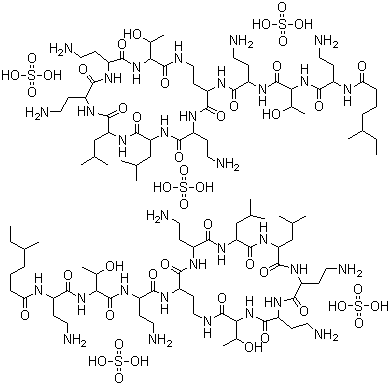
SynonymsN-[3-Amino-1-[[1-[[3-amino-1-[[6,9,18-tris(2-aminoethyl)-3-(1-hydroxyethyl)-12,15-bis(2-methylpropyl)-2,5,8,11,14,17,20-heptaoxo-1,4,7,10,13,16,19-heptazacyclotricos-21-yl]carbamoyl]propyl]carbamoyl]-2-hydroxy-propyl]carbamoyl]propyl]-5-methyl-heptanamide sulfate
Molecular StructureCAS # 1264-72-8, Colistin sulfate
Molecular Formula2(C52H98N16O13).5(H2SO4)
Molecular Weight2801.26
CAS Registry Number1264-72-8
EC Number215-034-3
SMILES[S](=O)(=O)(O)O.N1[C@H](C(=O)NCC[C@@H](C(=O)N[C@H](C(=O)N[C@@H](C(=O)N[C@H](C(=O)N[C@H](C(=O)N[C@H](C1=O)CCN)CCN)CC(C)C)CC(C)C)CCN)NC(=O)[C@@H](NC(=O)[C@@H](NC(=O)[C@@H](NC(=O)CCCCC(CC)C)CCN)[C@H](O)C)CCN)[C@H](O)C
Properties
Melting point200-220 °C
Safety Data
Hazard Symbolssymbol   GHS06 Danger  Details
Risk StatementsH301  Details
Safety StatementsP264-P270-P301+P316-P321-P330-P405-P501  Details
Hazard Classification
up    Details
HazardClassCategory CodeHazard Statement
Acute toxicityAcute Tox.3H301
Acute toxicityAcute Tox.4H302
Specific target organ toxicity - repeated exposureSTOT RE1H372
Transport InformationUN 2811
SDSAvailable
up Discovery and Applications
Colistin sulfate is a polypeptide antibiotic that belongs to the polymyxin class, primarily used to combat infections caused by Gram-negative bacteria. It is a sulfate salt form of colistin, also known as polymyxin E, which was originally discovered in the late 1940s from the bacterium *Bacillus polymyxa* subsp. *colistinus*. The active components of colistin are polymyxin E1 and polymyxin E2, cyclic peptides with a fatty acid tail that exhibit potent antibacterial activity through disruption of bacterial cell membranes.

The initial discovery of colistin occurred during the search for new antibiotics in soil-derived microorganisms. As antibiotic resistance began to rise in the mid-20th century, especially among Gram-negative pathogens, the discovery of colistin represented a significant development due to its efficacy against problematic bacteria such as *Pseudomonas aeruginosa*, *Acinetobacter baumannii*, and certain strains of *Klebsiella pneumoniae*. However, due to concerns about nephrotoxicity and neurotoxicity, colistin's use in human medicine declined with the emergence of less toxic alternatives.

Colistin sulfate differs from colistimethate sodium, another pharmaceutical form of colistin, in its pharmacological characteristics and route of administration. While colistimethate sodium is commonly used parenterally for systemic infections, colistin sulfate is more frequently used for oral or topical administration, as well as for gastrointestinal decontamination. Colistin sulfate is poorly absorbed from the gastrointestinal tract, which makes it suitable for treating intestinal infections without significant systemic exposure.

The mechanism of action of colistin sulfate involves interaction with the outer membrane of Gram-negative bacteria. The positively charged amino groups of colistin bind to the negatively charged lipid A component of lipopolysaccharides (LPS) in the bacterial outer membrane. This disrupts membrane integrity by displacing divalent cations such as Mg2+ and Ca2+ that stabilize LPS. The resulting increased permeability leads to leakage of intracellular contents and ultimately bacterial cell death. This mode of action is specific to Gram-negative organisms, as Gram-positive bacteria lack the outer membrane targeted by colistin.

The reintroduction of colistin into clinical practice began in the early 2000s as multidrug-resistant (MDR) and extensively drug-resistant (XDR) bacterial strains became increasingly prevalent. Colistin sulfate was revisited as a last-resort treatment option for infections that no longer responded to carbapenems and other broad-spectrum antibiotics. Its application is particularly important in treating ventilator-associated pneumonia, bloodstream infections, and complicated urinary tract infections caused by MDR pathogens.

In veterinary medicine, colistin sulfate has been widely used to treat enteric infections in livestock, especially in poultry and swine, due to its effectiveness against *Escherichia coli* and *Salmonella* species. It has also been employed as a growth promoter in animal feed in some countries, although this practice has been restricted or banned in various regions due to concerns about the development and spread of resistance genes.

One of the most significant public health concerns related to colistin sulfate is the emergence of colistin resistance, particularly through plasmid-mediated mechanisms such as the *mcr-1* gene. This gene enables bacteria to modify lipid A with phosphoethanolamine, reducing colistin binding and rendering the bacteria resistant. The discovery of transferable colistin resistance in both clinical and agricultural settings has led to intensified surveillance and regulation of colistin use worldwide.

Pharmacokinetically, colistin sulfate is minimally absorbed when administered orally, with most of the drug excreted unchanged in the feces. When applied topically, it acts locally without substantial systemic exposure. For these reasons, colistin sulfate is often used for decontaminating the digestive tract in immunocompromised patients or as a prophylactic agent in specific surgical procedures.

Despite its clinical utility, colistin sulfate must be used with caution to minimize adverse effects and delay the development of resistance. Proper dosing, therapeutic drug monitoring, and stewardship programs are essential to ensure its continued efficacy in both human and veterinary medicine. The renewed interest in colistin sulfate underlines its importance as a critical option in the antibiotic arsenal, especially in the era of increasing antimicrobial resistance.

References

none
Market Analysis Reports
List of Reports Available for Colistin sulfate
Related Products
Colestilan  Colestipol  Colestipol Hydr...  Colestipol hydr...  Colfenamate  Colimecycline  Colipase  Colistimethate  Colistimethate ...  Colistin  Colistin-1,3,5,...  Colitose  Colivelin  Collagen  Collagenase  Collagen I, alp...  Collagen hydrol...  Collagen prolin...  Collagens, Laur...  Collagens, octa...