Online Database of Chemicals from Around the World

Indirubin
[CAS# 479-41-4]

List of Suppliers
Shanghai ZaiQi Bio-Tech Co., Ltd. China Inquire
www.chemzq.com
+86 (21) 5482-4098
+86 (21) 5482-4069
sales1@chemzq.com
QQ Chat
Chemical manufacturer since 2004
chemBlink Standard supplier since 2009
TCS Industry Limited China Inquire
www.tcsindustry.com
+86 (512) 5022-6427
lsenfy@gmail.com
Chemical manufacturer
chemBlink Standard supplier since 2009
Wilshire Technologies, Inc. USA Inquire
www.wilshiretechnologies.com
+1 (609) 683-1117
+1 (732) 274-0049
Wilshire-info@evonik.com
Chemical manufacturer since 1997
chemBlink Standard supplier since 2010
Shaanxi Green Bio-Engineering Co., Ltd. China Inquire
www.sxgreenfine.com
+86 (29) 8621-5910
8621-5920
8621-5930
+86 (29) 8621-5580
sxgreenfine@gmail.com
rql1107@hotmail.com
Chemical manufacturer
chemBlink Standard supplier since 2010
BOC Sciences USA Inquire
www.bocsci.com
+1 (631) 485-4226
+1 (631) 614-7828
info@bocsci.com
Chemical manufacturer
chemBlink Standard supplier since 2010
Aktin Chemicals Inc China Inquire
www.aktinchem.com
+86 400-028-7725
+86 (28) 8515-2372
info@aktinchem.com
QQ Chat
Chemical manufacturer
chemBlink Standard supplier since 2011
Hangzhou Leap Chem Co., Ltd. China Inquire
www.leapchem.com
+86 (571) 8771-1850
market19@leapchem.com
QQ Chat
Chemical manufacturer since 2006
chemBlink Standard supplier since 2015
Amadis Chemical Co., Ltd. China Inquire
www.amadischem.com
+86 (571) 8992-5085
+86 (571) 8992-5065
sales@amadischem.com
Chemical manufacturer since 2010
chemBlink Standard supplier since 2015
Chengdu Biopurify Phytochemicals Ltd. China Inquire
www.phytopurify.com
+86 (28) 8263-3860
8263-3987
+86 (28) 8263-3165
sales@biopurify.com
biopurify@gmail.com
QQ Chat
Skype Chat
Chemical manufacturer
chemBlink Standard supplier since 2017
Neostar United (Changzhou) Industrial Co., Ltd. China Inquire
www.neostarunited.com
+86 (519) 8555-7386
+86 18015025600
+86 (519) 8555-7389
marketing1@neostarunited.com
Chemical distributor since 2014
chemBlink Standard supplier since 2020
Cfm Oskar Tropitzsch GmbH Germany Inquire
www.cfmot.de
+49 (9231) 9619-0
+49 (9231) 9619-60
info@cfmot.de
Chemical distributor since 1985
chemBlink Standard supplier since 2022
Cheng Du Chenlv Herb Co., Ltd. China Inquire
www.chenlvherbs.com
+86 18981728582
chenlvherb@126.com
WeChat: Cheng Du Chenlv Herb Co., Ltd.
Chemical manufacturer since 2012
chemBlink Standard supplier since 2025
LKT Laboratories, Inc. USA Inquire
www.lktlabs.com
+1 (888) 558-5227
+1 (651) 644-8357
peacerli@mbolin-lktlabs.com
Chemical manufacturer
Santa Cruz Biotechnology, Inc. USA Inquire
www.scbt.com
+1 (831) 457-3800
+1 (831) 457-3801
scbt@scbt.com
Chemical manufacturer

Identification
ClassificationAPI >> Antineoplastic agents >> Natural source antineoplastic agents
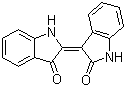
NameIndirubin
Synonyms2-(2-Oxo-1H-indol-3-ylidene)-1H-indol-3-one
Molecular StructureCAS # 479-41-4, Indirubin
Molecular FormulaC16H10N2O2
Molecular Weight262.26
CAS Registry Number479-41-4
EC Number610-392-0
SMILESO=C1Nc2ccccc2/C1=C1/Nc2ccccc2C1=O
Properties
Density1.4±0.1 g/cm3 Calc.*
Boiling point496.6±45.0 °C 760 mmHg (Calc.)*
Flash point207.0±28.9 °C (Calc.)*
Index of refraction1.709 (Calc.)*
*Calculated using Advanced Chemistry Development (ACD/Labs) Software.
Safety Data
Hazard Symbolssymbol   GHS07 Warning  Details
Risk StatementsH315-H319-H335  Details
Safety StatementsP261-P264-P264+P265-P271-P280-P302+P352-P304+P340-P305+P351+P338-P319-P321-P332+P317-P337+P317-P362+P364-P403+P233-P405-P501  Details
Hazard Classification
up    Details
HazardClassCategory CodeHazard Statement
Skin irritationSkin Irrit.2H315
Eye irritationEye Irrit.2H319
SDSAvailable
up Discovery and Applications
Indirubin is a naturally occurring bis-indole alkaloid primarily isolated from Indigofera tinctoriaand other indigo-producing plants. It is one of the active components of traditional Chinese medicine formulations, particularly in the treatment of chronic myelogenous leukemia and other hematological disorders. Structurally, indirubin is an isomer of indigo, characterized by its two indole moieties connected via a double-bonded carbonyl system, which confers its unique biological activities.

The discovery of indirubin dates back to the 19th century, when it was first identified as a pigment responsible for the red coloration in some indigo extracts. Subsequent investigations revealed that indirubin exhibits significant pharmacological properties distinct from its parent indigo compound. Early studies in traditional medicine highlighted its effectiveness in treating blood disorders, and modern research has focused on elucidating its molecular mechanisms and potential therapeutic applications.

Pharmacologically, indirubin is recognized for its antiproliferative and antitumor activities. It functions as an inhibitor of cyclin-dependent kinases (CDKs) and glycogen synthase kinase-3 (GSK-3), which play critical roles in cell cycle regulation and signaling pathways associated with tumor growth. By modulating these targets, indirubin can induce cell cycle arrest and apoptosis in malignant cells, making it a promising candidate for anticancer therapy. Research has also demonstrated its potential efficacy against leukemia, glioma, and other cancer types.

In addition to its anticancer effects, indirubin exhibits anti-inflammatory and neuroprotective activities. It can suppress the production of pro-inflammatory cytokines and reduce oxidative stress, contributing to its therapeutic potential in inflammatory and neurodegenerative conditions. These properties are mediated through the modulation of signaling pathways such as NF-κB, JAK/STAT, and MAPK, which are involved in inflammation and cellular stress responses.

The bioavailability of indirubin is relatively limited due to its poor water solubility and rapid metabolism, which has led to the development of various formulations to enhance its pharmacokinetic properties. Techniques such as nanoparticle encapsulation, liposomal delivery, and chemical modifications have been employed to improve solubility, stability, and tissue distribution, thereby increasing its therapeutic efficacy in preclinical models.

Clinically, indirubin has been used in traditional Chinese medicine for the management of leukemia and other chronic blood disorders, often as part of multi-component herbal formulations. Contemporary research continues to explore its potential as a lead compound for anticancer drug development, with a focus on understanding its molecular targets, optimizing its pharmacological profile, and evaluating its safety in clinical settings.

Overall, indirubin is a bioactive bis-indole alkaloid with a long history of medicinal use and demonstrated pharmacological activities. Its antiproliferative, anti-inflammatory, and neuroprotective effects, combined with ongoing advances in formulation and delivery strategies, highlight its potential for development as a therapeutic agent in oncology and other disease areas.

References

2025. Synergistic Sedative Activity of Indirubin on Diazepam in Thiopental Sodium-induced Sleeping Mice: A Potential GABAergic Transmission. Molecular Neurobiology.
DOI: 10.1007/s12035-025-05176-x

2008. Photoreactivity of indirubin derivatives. Photochemical & Photobiological Sciences, 7(3).
DOI: 10.1039/b711261k

1951. Effect of indirubin on white blood cell count of the guinea pig. Cellular and Molecular Life Sciences, 7(8).
DOI: 10.1007/bf02150557
Market Analysis Reports
List of Reports Available for Indirubin
Related Products
Indigo Naturali...  Indigosol O, Di...  Indigotetrasulf...  Indigotetrasulf...  Indigotrisulfon...  Indiloy  Indimitecan  Indinavir  Indinavir sulfa...  Indiplon  Indirubin 3'-mo...  Indisocin  Indisperse 5  Indisulam  Indium115  Indium113  Indium111  Indium  Indium acetate  Indium(III) Ace...