
Online Database of Chemicals from Around the World
| Capot Chemical Co., Ltd. | China | |||
|---|---|---|---|---|
 | www.capotchem.com | |||
 | +86 (571) 8558-6718 +86 13336195806 | |||
 | +86 (571) 8586-4795 | |||
 | capotchem@gmail.com sales@capotchem.com | |||
 | QQ Chat | |||
| Chemical manufacturer | ||||
| chemBlink Standard supplier since 2006 | ||||
| Sanming Hexafluo Chemicals Co., Ltd. | China | |||
|---|---|---|---|---|
| www.hexafluo.com | |||
| +86 (598) 281-7768 | |||
| +86 (598) 286-6778 | |||
| info@hexafluo.com | |||
| Chemical manufacturer since 2007 | ||||
| chemBlink Standard supplier since 2008 | ||||
| Wuhan Comings Biotechnology Co., Ltd. | China | |||
|---|---|---|---|---|
| comings.en.made-in-china.com | |||
| +86 13659820406 | |||
| info@comingschemi.com | |||
| QQ Chat | |||
| Chemical manufacturer since 2016 | ||||
| chemBlink Standard supplier since 2023 | ||||
| Marshallton Research Laboratories | USA | |||
|---|---|---|---|---|
| www.marshalltonlabs.com | |||
| +1 (336) 983-2131 | |||
| +1 (336) 983-0096 | |||
| marshallton@windstream.net | |||
| Chemical manufacturer since 1974 | ||||
| Classification | Organic raw materials >> Organic fluorine compound >> Fluoropropane series |
|---|---|
| Name | 2,2-Bis(4-aminophenyl)hexafluoropropane |
| Synonyms | 4,4'-(Hexafluoroisopropylidene)dianiline |
| Molecular Structure | 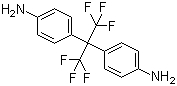 |
| Molecular Formula | C15H12F6N2 |
| Molecular Weight | 334.26 |
| CAS Registry Number | 1095-78-9 |
| EC Number | 600-922-9 |
| SMILES | C1=CC(=CC=C1C(C2=CC=C(C=C2)N)(C(F)(F)F)C(F)(F)F)N |
| Density | 1.4$+/-$0.1 g/cm3 Calc.* |
|---|---|
| Melting point | 195 - 198 $degree$C (Expl.) |
| Boiling point | 351.2$+/-$42.0 $degree$C 760 mmHg (Calc.)* |
| Flash point | 159.4$+/-$18.6 $degree$C (Calc.)* |
| Index of refraction | 1.527 (Calc.)* |
| * | Calculated using Advanced Chemistry Development (ACD/Labs) Software. |
| Hazard Symbols |  GHS07 Warning Details GHS07 Warning Details | ||||||||||||||||
|---|---|---|---|---|---|---|---|---|---|---|---|---|---|---|---|---|---|
| Risk Statements | H315-H319-H335 Details | ||||||||||||||||
| Safety Statements | P261-P264-P264+P265-P271-P280-P302+P352-P304+P340-P305+P351+P338-P319-P321-P332+P317-P337+P317-P362+P364-P403+P233-P405-P501 Details | ||||||||||||||||
| Hazard Classification | |||||||||||||||||
| |||||||||||||||||
| SDS | Available | ||||||||||||||||
 Discovery and Applications
|
2,2-Bis(4-aminophenyl)hexafluoropropane is an aromatic diamine in which two para-aminophenyl groups are attached to a central hexafluoropropane unit. Compounds of this type have been developed and extensively used in polymer chemistry, particularly in the preparation of high-performance fluorinated polymers. The combination of electron-withdrawing trifluoromethyl groups and reactive amino functionalities provides a balance of chemical reactivity, thermal stability, and desirable physical properties in derived materials. The molecular structure consists of a central carbon atom bonded to two trifluoromethyl groups and two phenyl rings, forming a hexafluoroisopropylidene linkage. Each phenyl ring carries an amino group at the para position, resulting in a symmetrical diamine with two primary amine functionalities. The trifluoromethyl groups are strongly electron-withdrawing and introduce significant steric bulk, which reduces intermolecular interactions and affects the packing of molecules in solid materials. The presence of fluorine atoms also enhances chemical resistance and thermal stability. The synthesis of 2,2-bis(4-aminophenyl)hexafluoropropane is typically achieved through nitration of the corresponding bisphenol derivative followed by reduction of the nitro groups to amino groups. Such synthetic routes have been well established to produce high-purity diamines suitable for polymerization. Control of reaction conditions ensures that substitution occurs at the para positions and that the integrity of the hexafluoropropane linkage is maintained. One of the most important applications of this compound is in the production of polyimides. As a diamine monomer, it reacts with aromatic dianhydrides to form polymers with excellent thermal stability, mechanical strength, and chemical resistance. The hexafluoroisopropylidene group plays a key role in modifying the properties of these polymers by increasing free volume and reducing chain packing. This results in improved solubility and processability compared to non-fluorinated polyimides, while maintaining high performance at elevated temperatures. The presence of fluorinated groups also contributes to low dielectric constants and low moisture absorption in the resulting materials. These properties are particularly important in electronic and microelectronic applications, where materials are required to maintain performance under varying environmental conditions. As a result, polymers derived from this diamine are used in insulating layers, flexible circuits, and advanced coatings. In addition to polyimides, 2,2-bis(4-aminophenyl)hexafluoropropane is used in the synthesis of other high-performance polymers such as polyamides and epoxy resins. The amino groups readily react with various electrophilic monomers, allowing the formation of networks or linear polymers with tailored properties. The bulky and electron-withdrawing nature of the hexafluoropropane core can also improve optical transparency and reduce coloration in the resulting materials, which is advantageous in optical and display technologies. Overall, 2,2-bis(4-aminophenyl)hexafluoropropane is a key fluorinated diamine widely used in advanced polymer synthesis. Its combination of reactive amino groups, a bulky and electron-withdrawing central unit, and excellent thermal and chemical stability makes it an important building block for high-performance materials used in electronics, aerospace, and other demanding applications. References 2025. Spontaneous orientation polarization driven by designing molecular asymmetry. Communications Materials. DOI: 10.1038/s43246-025-00815-1 2024. Thermally cross-linkable hole-transport materials enable solution-processed blue OLED with LT95 over 150 h. Science China Materials. DOI: 10.1007/s40843-024-2888-2 2023. Aerogels from Engineering Polymers: Polyimide and Polyamide Aerogels. Springer Handbook of Aerogels. |
| Market Analysis Reports |