
Online Database of Chemicals from Around the World
| Wuhan Comings Biotechnology Co., Ltd. | China | |||
|---|---|---|---|---|
 | comings.en.made-in-china.com | |||
 | +86 13659820406 | |||
 | info@comingschemi.com | |||
 | QQ Chat | |||
| Chemical manufacturer since 2016 | ||||
| chemBlink Standard supplier since 2023 | ||||
| Frinton Laboratories, Inc. | USA | |||
|---|---|---|---|---|
| www.frinton.com | |||
| +1 (856) 722-7037 | |||
 | +1 (856) 439-1977 | |||
| sales@frinton.com frinton@frinton.com | |||
| Chemical manufacturer since 1963 | ||||
| Classification | Chemical reagent >> Organic reagent >> Polyamine |
|---|---|
| Name | 4,4'-Ethylenedianiline |
| Synonyms | alpha,alpha'-Bi-p-toluidine; 4,4'-Diaminobibenzyl |
| Molecular Structure | 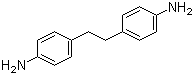 |
| Molecular Formula | C14H16N2 |
| Molecular Weight | 212.29 |
| CAS Registry Number | 621-95-4 |
| EC Number | 210-716-7 |
| SMILES | C1=CC(=CC=C1CCC2=CC=C(C=C2)N)N |
| Density | 1.1$+/-$0.1 g/cm3 Calc.* |
|---|---|
| Melting point | 133 - 137 $degree$C (Expl.) |
| Boiling point | 381.9$+/-$22.0 $degree$C 760 mmHg (Calc.)* |
| Flash point | 220.6$+/-$21.8 $degree$C (Calc.)* |
| Index of refraction | 1.654 (Calc.)* |
| * | Calculated using Advanced Chemistry Development (ACD/Labs) Software. |
| Hazard Symbols |   GHS07;GHS09 Warning Details GHS07;GHS09 Warning Details | ||||||||||||||||||||||||||||||||||||||||||||
|---|---|---|---|---|---|---|---|---|---|---|---|---|---|---|---|---|---|---|---|---|---|---|---|---|---|---|---|---|---|---|---|---|---|---|---|---|---|---|---|---|---|---|---|---|---|
| Risk Statements | H315-H319-H335-H400-H410 Details | ||||||||||||||||||||||||||||||||||||||||||||
| Safety Statements | P261-P264-P264+P265-P271-P273-P280-P302+P352-P304+P340-P305+P351+P338-P319-P321-P332+P317-P337+P317-P362+P364-P391-P403+P233-P405-P501 Details | ||||||||||||||||||||||||||||||||||||||||||||
| Hazard Classification | |||||||||||||||||||||||||||||||||||||||||||||
| |||||||||||||||||||||||||||||||||||||||||||||
| SDS | Available | ||||||||||||||||||||||||||||||||||||||||||||
 Discovery and Applications
|
4,4'-Ethylenedianiline is an aromatic diamine compound in which two aniline groups are connected via an ethylene (–CH2–CH2–) bridge at the para positions of each benzene ring. This structure combines the nucleophilic reactivity of the amino groups with the flexibility provided by the ethylene linkage, making the compound an important intermediate in polymer chemistry, organic synthesis, and materials development. The molecule’s bifunctional nature allows it to participate in a variety of condensation and crosslinking reactions. The molecular structure consists of two para-substituted benzene rings connected by an ethylene bridge, with each ring bearing a primary amino group. The para-oriented amino groups serve as nucleophilic centers that can undergo acylation, sulfonylation, and polycondensation reactions, while the ethylene linkage provides flexibility, which can influence the physical properties of polymers and materials synthesized from this diamine. The combination of aromatic rigidity and alkyl flexibility allows for tuning of mechanical, thermal, and chemical characteristics in downstream applications. Synthesis of 4,4'-ethylenedianiline generally involves the reaction of 4-nitroaniline derivatives with ethylene or ethylene-containing precursors, followed by reduction of the nitro groups to yield the diamine. Reaction conditions are carefully controlled to achieve selective coupling, avoid overreaction, and obtain high-purity product suitable for use as a chemical intermediate. Alternative routes may include hydrogenation or catalytic reduction strategies to convert nitro precursors to the final diamine. One of the primary applications of 4,4'-ethylenedianiline is in polymer production. Its diamine functionality allows it to serve as a monomer in the synthesis of polyimides, epoxy resins, and polyurethane prepolymers. In these applications, the amino groups react with anhydrides, epoxides, or isocyanates to form polymer chains or crosslinked networks. The ethylene bridge contributes to polymer flexibility while the aromatic rings impart thermal stability, mechanical strength, and chemical resistance. Polymers derived from this compound are used in adhesives, coatings, electronic components, and composite materials. In addition to polymer applications, 4,4'-ethylenedianiline is used as an intermediate in organic synthesis for producing dyes, pigments, and functional aromatic derivatives. Its amino groups can participate in diazotization and coupling reactions, enabling the formation of azo dyes and other colored compounds. The combination of nucleophilic reactivity, aromatic structure, and flexible ethylene linkage allows chemists to design molecules with specific physical and chemical properties. Overall, 4,4'-ethylenedianiline is a multifunctional aromatic diamine with broad utility in polymer chemistry, organic synthesis, and material science. Its para-oriented amino groups and ethylene bridge provide both chemical reactivity and structural versatility, making it a valuable intermediate for the synthesis of high-performance polymers, dyes, and functional chemical compounds. References 2023. Multimodal action of KRP203 on phosphoinositide kinases in vitro and in cells. Biochemical and Biophysical Research Communications. DOI: 10.1016/j.bbrc.2023.08.050 2022. A quantitative high-throughput screen identifies compounds that lower expression of the SCA2-and ALS-associated gene ATXN2. The Journal of biological chemistry. DOI: 10.1016/j.jbc.2022.102228 2021. Rheological and simulation for macromolecular matrix epoxy bi-functional aromatic amines. Polymer Bulletin. DOI: 10.1007/s00289-021-03862-z |
| Market Analysis Reports |